November 2024
South Hebron Hills
Refugee Camps
I once again set out for Palestine. This time though I was going to enter via Jordan which I heard was easier security wise. The first leg was a night flight from Toronto to Amsterdam with a stopover in Iceland. In Amsterdam I booked into a hotel to get some rest. Then a shuttle to airport for a flight to Amman, Jordan which had a nine hour layover in Cairo, Egypt. Once in Cairo, I found an earlier flight to Amman so changed the ticket. However that put me at the Amman airport at one in the morning with no place to go. And the bridge to Israel would not open until seven a.m.

After about an hour, I went out of the airport and spoke to a young man about going to the bridge which would be more than an hour drive. He said he would take me and also wait with me there since there was no where at the bridge to sit, etc. So we left picking up some coffee nearby and then by four he took me to a restaurant and paid for breakfast. Then off to the bridge and we got there around five a.m. so a long wait. He put his seat back and slept and I also tried to get some shut eye. I had told him I could wait alone but he would not hear of it. And he just charged $35 dinars. Eventually other people came including two young people from Italy.
So at seven we could finally go into the first part of the bridge where we waited some more. The Italian girls had done this before and so let me know I had to fill a form and go to a man in a booth to get it stamped. After that, we waited some more. Then another man at another booth stamped the paper again. Then someone collected the passports. Finally we could get on a bus which we had to pay for. (I could have swam across the Jordan River faster than this). Then finally to the other side? I expected to see the river but did not. Just mounds and mounds of dirt. We lined up at customs but when it was my turn, only one person was open and he just took my passport and asked one question and I was good to go and get my visa.
Once back outside, there were vehicles to take us places so I got a ticket for Jerusalem. The small bus stopped near Damascus gate so that was good. I thought to go to Bethlehem right away but decided that I would get some sleep and try Ecce Homo Pilgrim House on the Via Dolorosa. I checked into Ecce Homo and opted for a dorm room in a section that had a shared bathroom since they were less expensive. There were very few guests since many tourists had not returned. The views from the area where we could sit were expansive and impressive. I was able also to join in on the Sabeel study in the evening via zoom.


After the first day, I decided to stay another night since I had been coughing and wanted to be fine before heading to the South Hebron Hills. During the daytime on Friday, I took the bus to Bethlehem and walked to Wi’am Conflict Resolution Center. The director was not there but an employee was and he was there to meet with Joyce who came at about the same time as I did. Joyce Penfield had been with the solidarity group that Omar Harmany was leading and I knew some from Canada had been part of it. She talked about her work in Cambodia and had written the book: Before You Die, Plant a Tree: Practical Lessons for Peace Building from Cambodia. Joyce mentioned that some from the group were staying a few extra days at Bethlehem Bible College. I asked about changes in the last year. He mentioned that they could no longer get grants and programs and their hours were cut. Some funding also came from tourist groups who came to hear speakers, etc at the center but few tourists. Also there were more incursions by the IDF and they could enter your homes and arrest people at will. He told of one recent incident close to his home. Then a quick lunch and the bus back to Jerusalem and of course having to stop at a checkpoint and everyone getting off the bus to show their permits to enter Jerusalem. I had to show my passport and visa.
I got up late the next day and after breakfast, left for Bethlehem. I had decided to stay at House of Hope. There I was the only one in the guest house. Sami was there and recognised me from last year. Last year he made sure I was fed and always checked up on me. It was good to see him. It was last Nov. that I had breakfast with the director and also sitting in his office when the man who had interviewed Franklin Graham came in. Graham is president of Samaritan’s purse and was in Jerusalem to give to Israel. Of course nothing for Palestinians in Gaza. Also he mentioned their support of Trump and that Trump was being persecuted. I had trouble keeping my mouth shut but showed great restaint.
Also last year, none of the buses were running from their usual places. Barriers were everywhere then and I had to take a taxi to an area in Beit Jala and walk past a barrier and then wait for the bus which were not running as often.
On Sunday I went to Lutheran Church. I had contacted Rev. Munther Isaac and he let me know the service would be by their cemetery – which they do once a year. It so happened it was a three minute walk from House of Hope. You cannot see it from the road since it is behind a large building.
When I walked into the chapel where the service was being held, Debbie came up to me and said imagine having to come to Palestine to see you!. She was an EA (Ecumenical Accompanier).at the same time as I and is from BC. With her were two men and the one is from St Catharines and goes to Grace Mennonite Church. They had been with the solidarity group also and stayed a few days more to visit more places.

South Hebron Hills
On Monday morning I finally left for Yatta via Hebron in a mini bus. There is no schedule but the bus leaves when they are full which is seven passengers. Inexpensive. I arrived at Abed’s home in Yatta. His wife, Sausan and four boys make me feel welcome and like part of the family. I had lived next door to them when an EA. I was disappointed to find out there is still no EA team for the South Hebron Hills (SHHs)- not since being pulled out last October. It seems like they leave when they are still needed. I understand though since the organization would be held responsible.
The day after I arrived, we went to Susiya where Abed is from and many family members sitll live including his father. Unbelievable what people have to go through so settlers or soldiers do not see. The back dirt rocky road and the long walk over rough terrain and all the time Abed scared that the soldiers will see and take his car. He only puts in enough gas so that money is not wasted if they take the car and he had put in a lot of gas. There was a plastic bottle with some gas in it by my feet in case he ran out. Then the long walk hoping settlers do not attack. Always being in fear.
While in Susiya, I walked around the village with Ahmed. Nassar, Ahmed and Eid who is from Um Al Khair were with a delegation to the US to talk to some from the Congress and also speak at some other venues. Ahmed said the best part was when they were in a church and Muslim, Christians and Jews were there together. He also spoke about no rights for Palestinians – that Israel controls everything and life is hard. They are not allowed an airport for example and have to go to Jordan. In the video below, he tells of a recent incident when soldiers came at 3 am looking for someone. Even your home is not a safe place since settlers or soldiers can enter at any time and you are powerless to stop them.
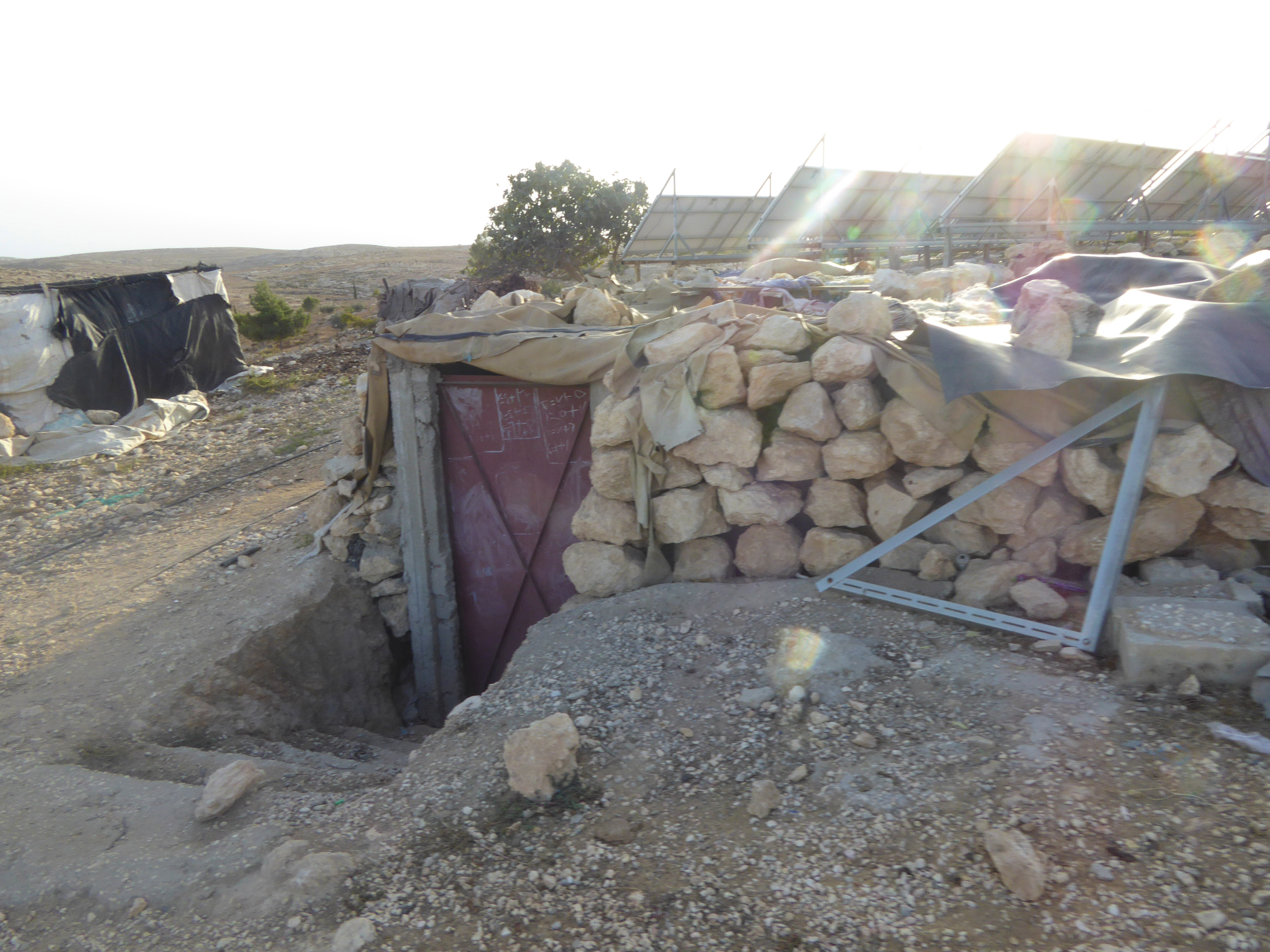
Homes in Susiya are makeshift shelters since their homes are bulldozed time and again in an effort to drive them off their land. So they rebuilt from whatever they can to stay in their land. There are solar panels donated by COMET ME to provide electricity

This picture was taken was when in Susiya in 2020, Then there were Israeli young people to show solidarity. They are pictured in front of the home where Ahmed lives. When there in Nov. 2023, there were no Israelis and the roads were all sealed off. I know that Israelis belonging to the organization called Taayush do come to the South Hebron Hills to be in solidarity as well as others e.g. Rabbis for Human Rights and Torat Tzedek. However I did not encounter them on this trip.
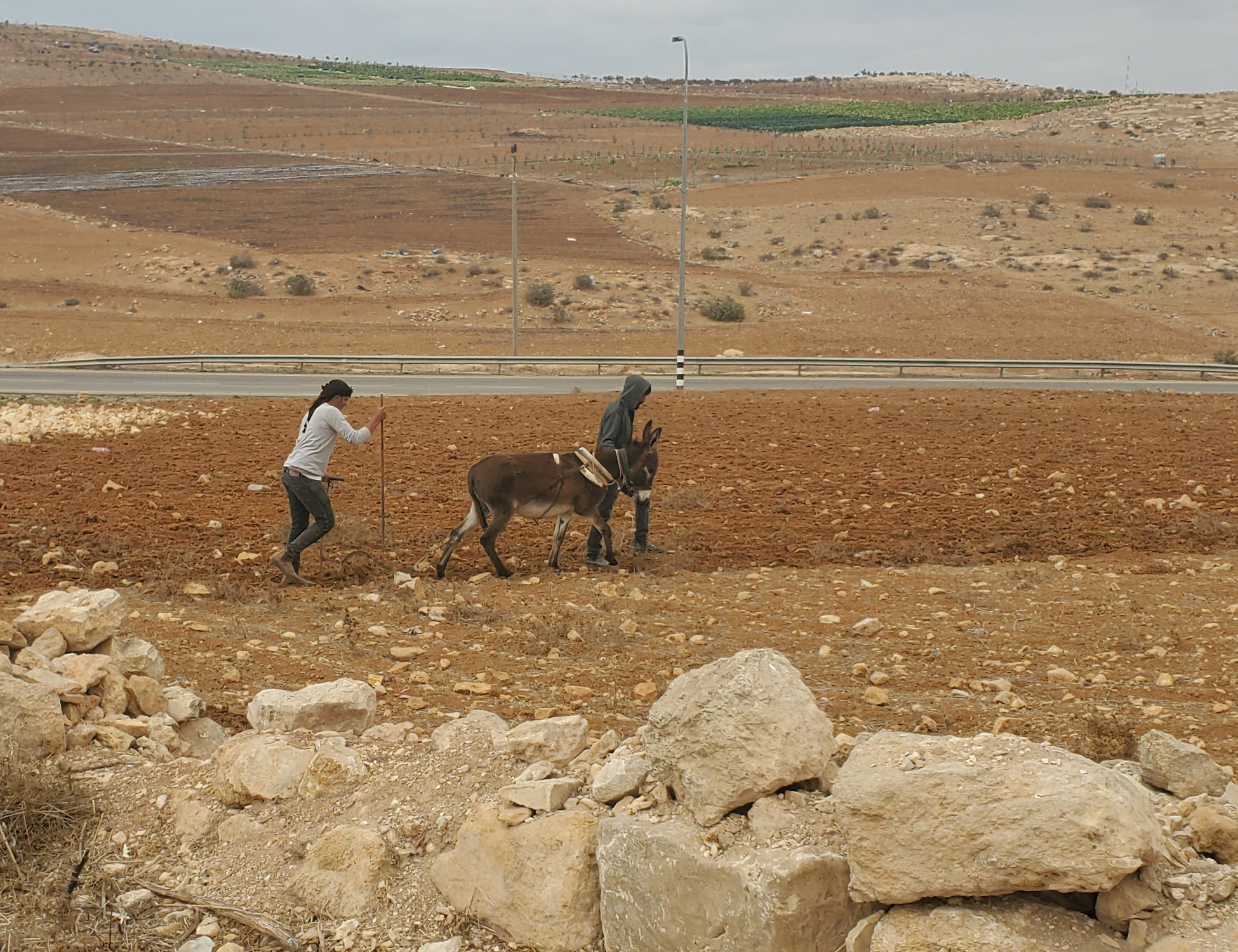
On Wednesday, I wanted to visit At Tawani. I walked there from Abed’s land where Desmond and I once helped plant olive trees. Abed could not use the roads near At Tuwani so I hiked down to the main Israeli road which I needed to cross. First I saw two men with a donkey doing plowing. Lots of rocks. They were plowing and wanting to get seeding done so things can grow as the raining season has come. I fear that they may never see a harvest since the field is in view of settlers.
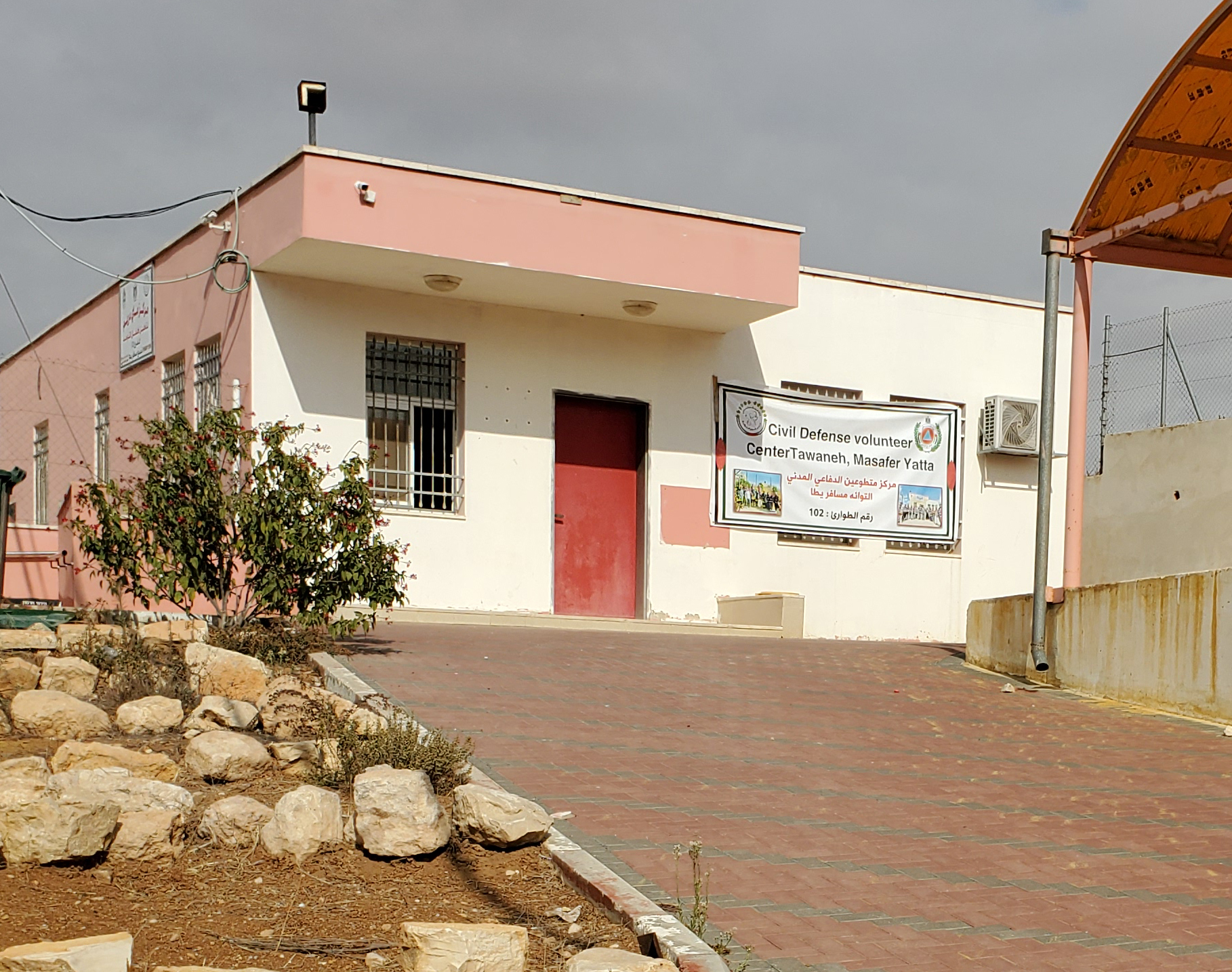
I passed the kindergarten building where I once went for the graduation with Hamed. His organization had funded the building of the kindergarten. Some years ago, the army came with bulldozers to demolish it. But the mothers and children stayed in the building and there were internationals there to film. Evenually the army and bulldozers left so good to see it still standing. It would not look good to tear it down on top of people or to be dragging women and children out in front of international press.
Everywhere are hills so walking is a good workout. I went up to where the Hurainis live to see if I could speak with Sami. He was not home but did speak with his father, Hafez, and his mother served tea and snacks. After a half hour or so, Sami came and I videoed him telling of the changes in the last year. I mentioned that I wanted to go to Al Fagara in the firing zone. He and his father both said that you cannot walk there. The army or the settlers will see you and you would be deported or beaten or both. I then went to see if people belonging to Operation Dove were at their placement house which is located in At Tuwani were available. They were there and they said that they too can no longer walk but need to go by car. This is just another way to try to keep internationals from seeing what is going on.
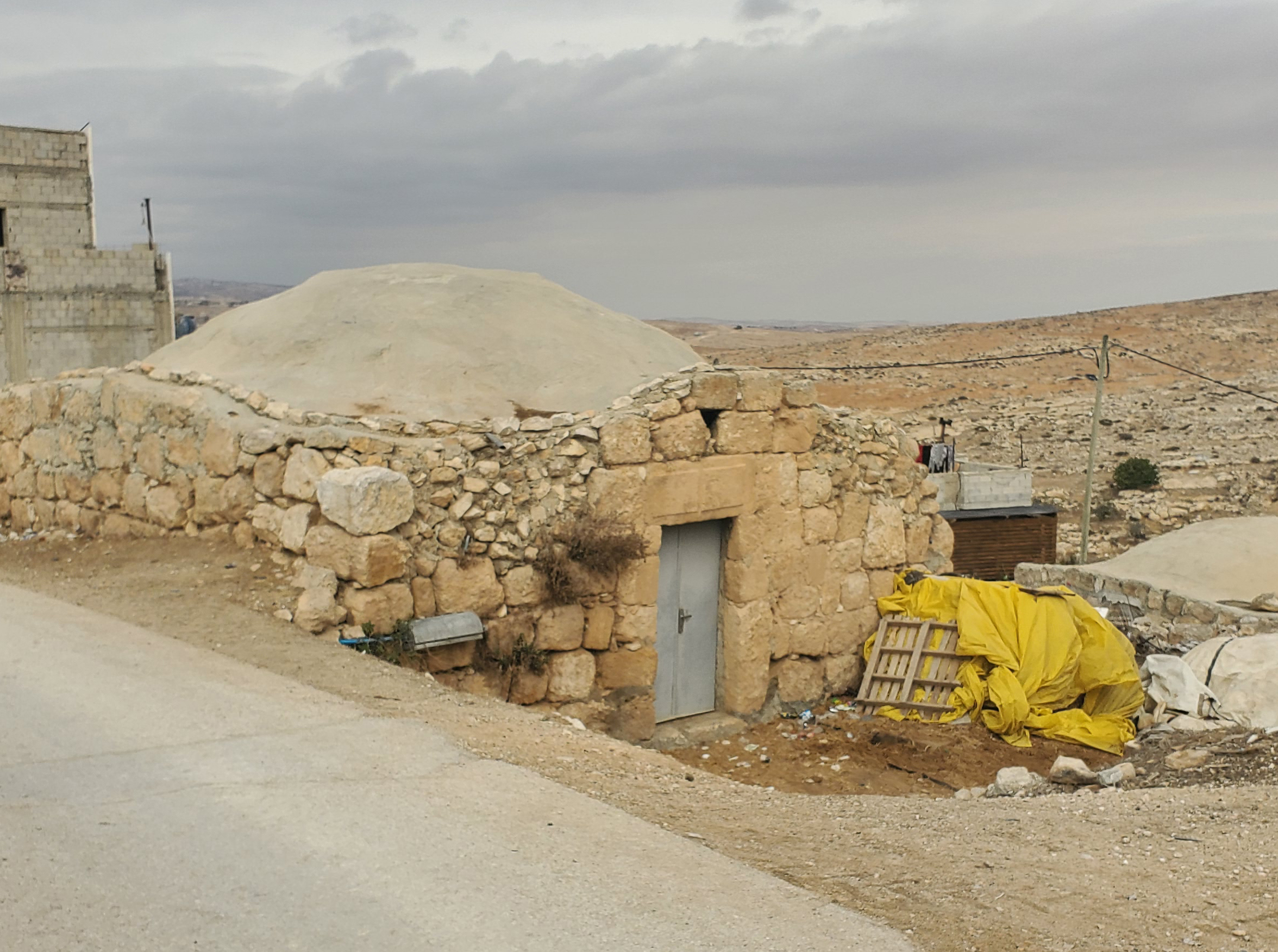
I then headed to the school for grades one to 12. On the way were some ancient homes. At Tuwani has a master plan so it is not like the villages where homes are demolished. However it does not stop the settlers or army from incursions which has only intenseified since Oct. 2023. In November, 2023 the director of the school was arrested and masked soldiers/settlers invaded the school. The settlers/soldiers took down Palestinian flags, and made threats before harassing people in the village.
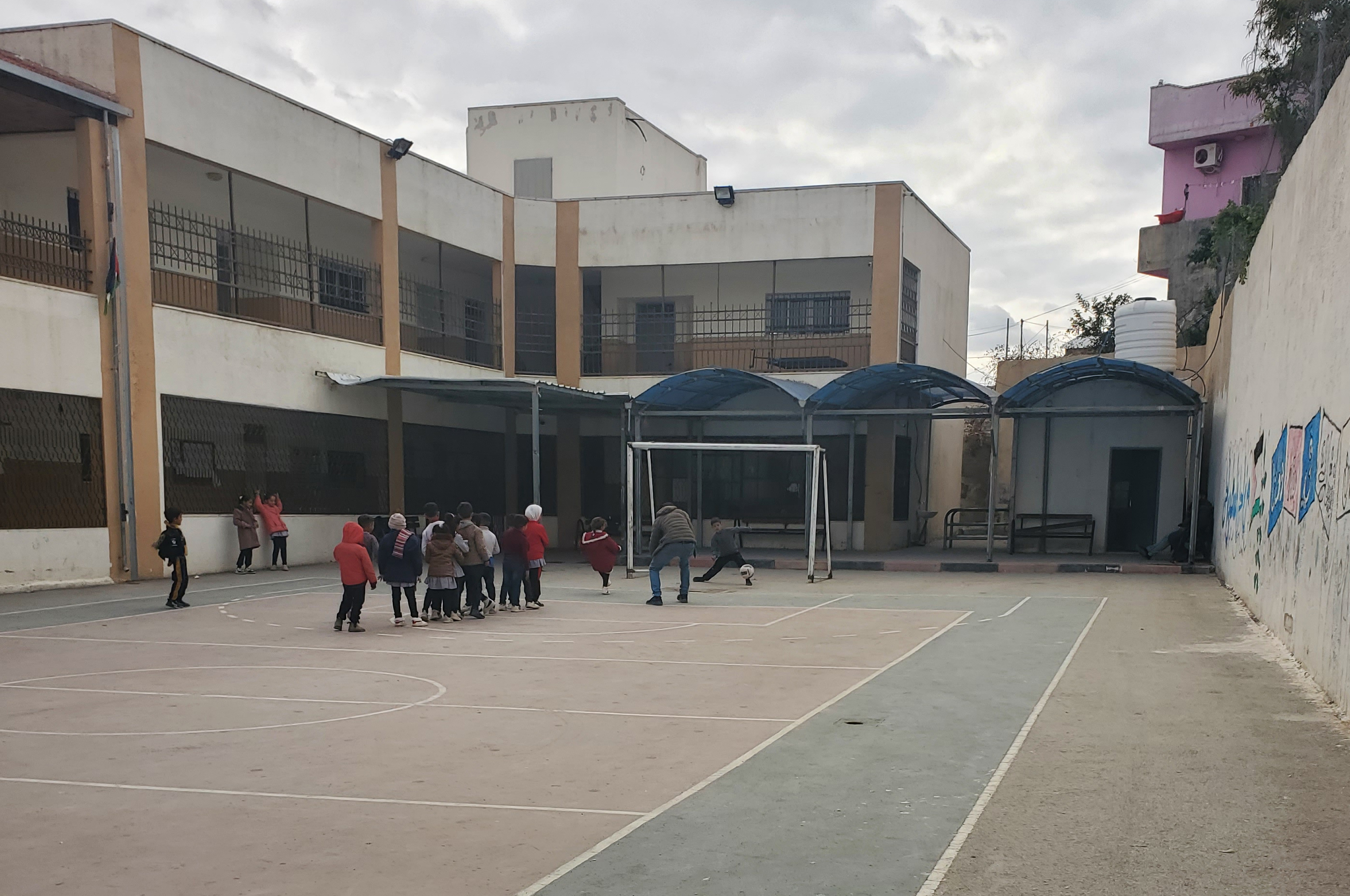
Behind the school is the school yard. A teacher and some of the younger students were lined up to kick a soccer ball into a net. I also lined up and took a turn. Missed by a country mile! I feigned my distress and then the teacher showed me up by kicking the ball into the net. I am sure the children will go home and mention that some old lady was no Ronaldo.
I then went to the office and talked to the school administrator. Schools started opening back up in February. However they are just open for four days a week. I also aked about the children that once came from the Firing Zone, especially those from Tuba. See earlier post about this when I was an EA. They now go to a school in the Firing Zone.
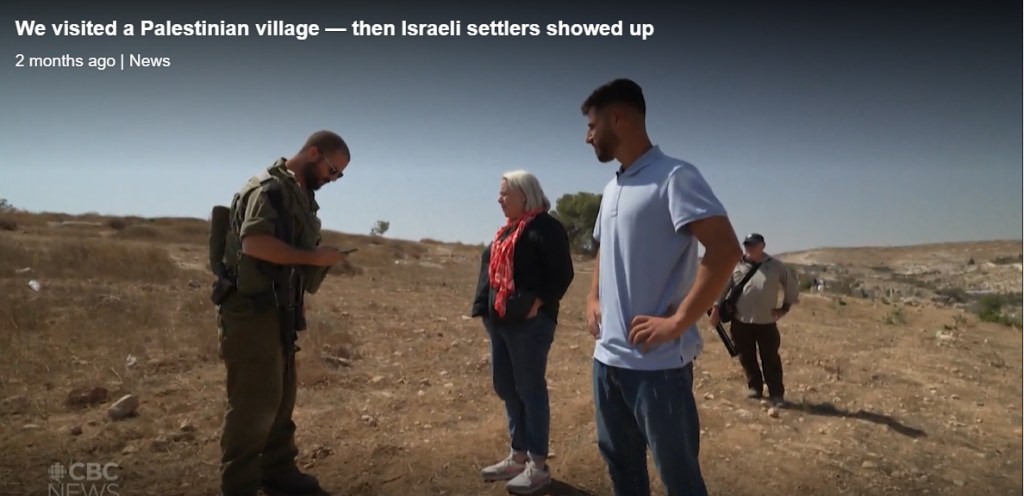
A few weeks before I was in At Tuwani, CBC was there and was filming when settlers showed up. The man mentioned that was arrested was Hafez Huraini. and Alex is Sami’s younger brother.
On Thursday, I once again had occasion to visit Susiya, this time with Fatma and she could take the road to the village. I had spent the night at her home in Yatta. She supports women from the villages teaching them first aid and facilitating group meetings to hear and share their fears and struggles. This time, Nassar was in Susiya and he greeted me as an old friend. I was again treated to a sit-on-the-floor lunch with others including Akmed. Ahmed mentioned that he saw me at the school since he is in grade 12 but could not come out as the class was in progress. Akmed is Nassar’s son. Nassar’s youngest child is disabled and, at the age of five, can just roll and she has to eat soft foods. Nassar has taken her to many doctors but they can only give her something for pain when she cries. Nassar would like a standing frame for her – one that can adjust as she grows and has good support and also has a tray. I hoped that this was a project I may be able to take on.
Later, we went to Um al Khair. I took photos and had tea with some ladies on what was the floor of her home which had recently been demolished by the Israelis. I think the residents know that sooner or later it will come and they would have to make something quickly for shelter and warmth. Demolitions usually go up in the rainy season to make life miserable. Um al Khair is unique in that it is right beside a settlement and they see eachother. At one time, on a fairly level area near the fence, Palestinians children were playing soccer and soon some Israeli children were watching and when the ball accidently went over the fence, the few settlement children watching would throw it back. Of course it was not long before the bulldozers, etc came and put large boulders to prevent the area being used for soccer.
The settlement has good roads, homes, running water, electricity all of which is denied to the people in the village.
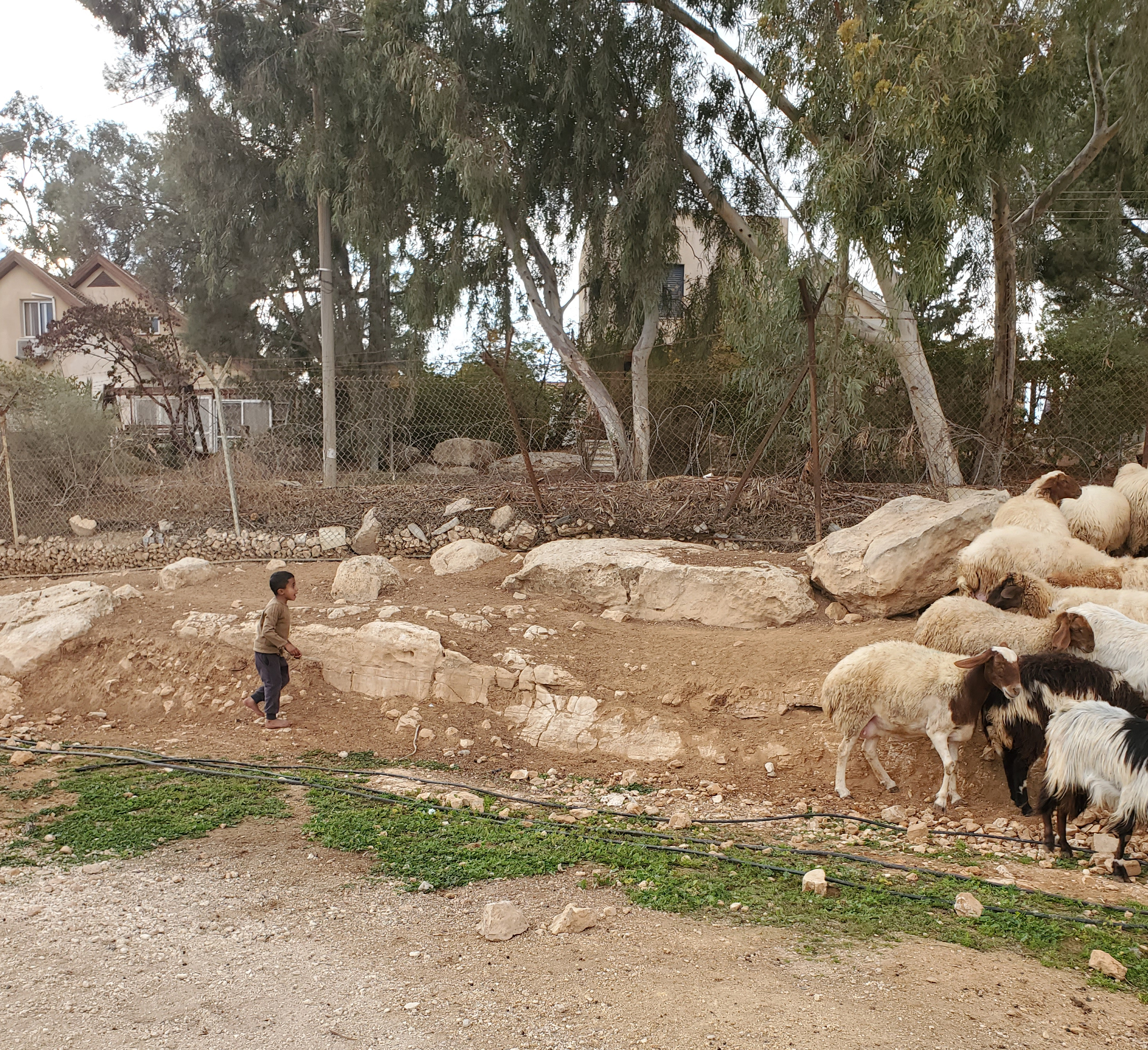
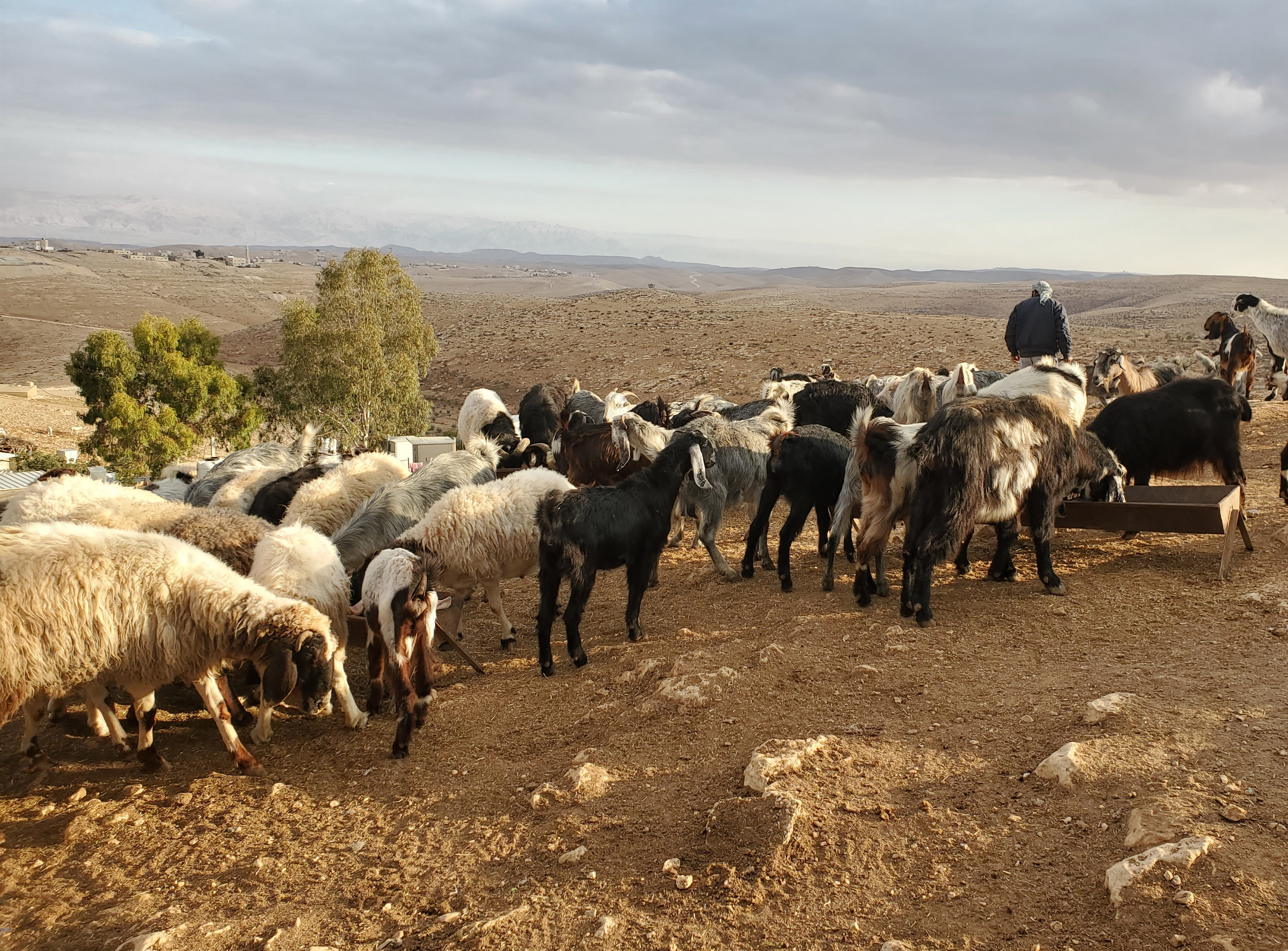
Sheep are important for their livelihoods.

Had tea on the foundation of what was recently a home.
It has been difficult since it is dangerous even to go out with their sheep. The only way to hang onto their land is to refuse to leave no matter the difficulties. See artical about Um al Khair and the ongoing trauma they face. More and more villages have been totally destroyed and more and more land taken. Some of the villages in the South Hebron Hills I once visitied are no more. And these challanges apply to all villages in Area C.
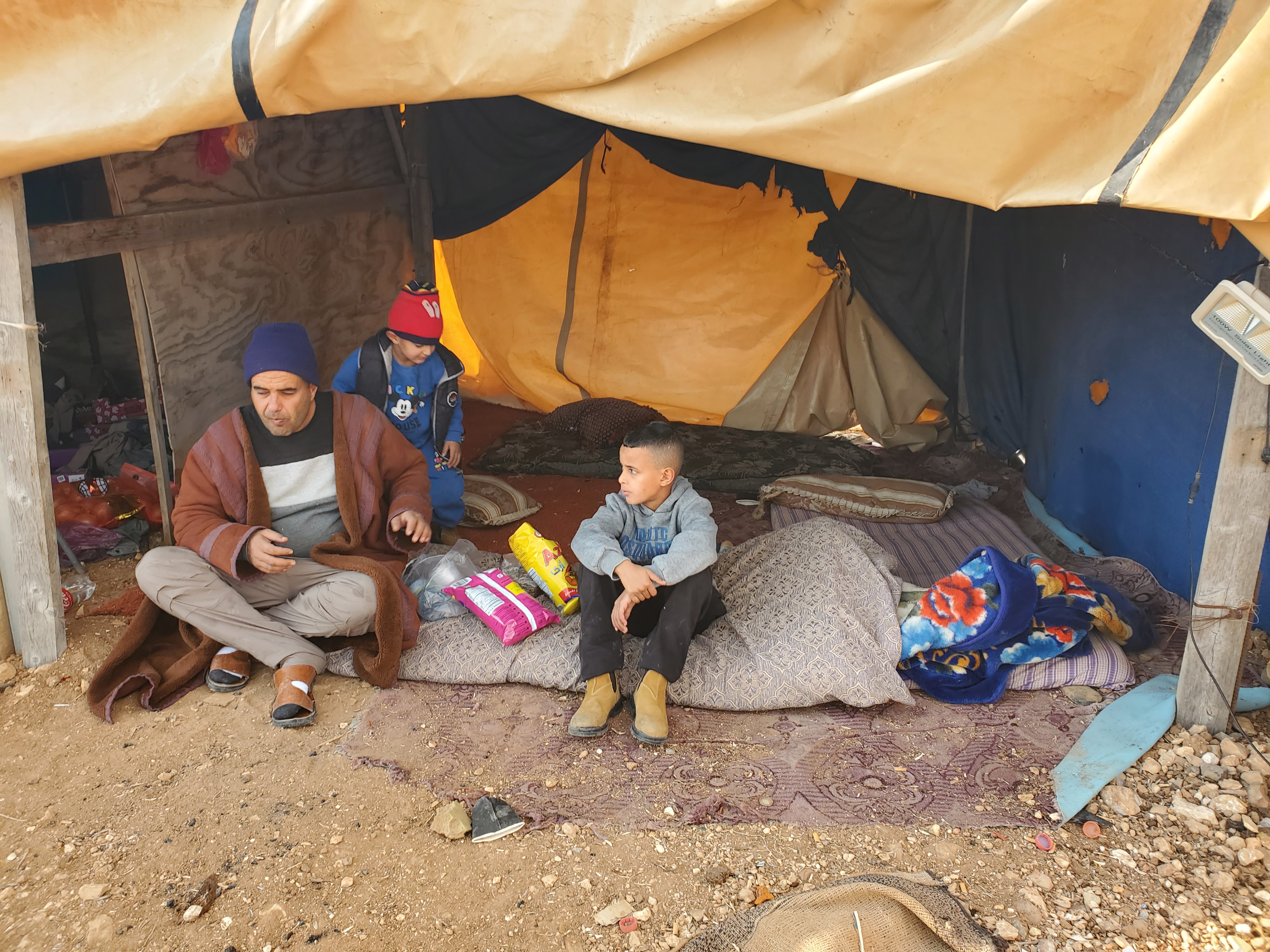
I returned to Abed’s home. He insisted I stay longer. The next day he wanted to have a “picnic” on his land. So we spent time there and had coffee, cold drinks and snacks. From there I could see At Tuwani and also the settlements surrounding it. Wherever you see a lot of trees, you know that is a settlement since they get plenty of water and planting trees is one way to cover up places where there was once a Palestinian village. Back at his home, he made a fire outside to make a traditional meal. It was an enjoyable day and evening. I also wanted to get something for his children so we had gone to a few shops.
Just as an aside, when visiting Abed in November 2023, he had been afraid to go to his land for fear of soldiers and settlers. He still goes in a way that avoids places where settlers or soldiers may see him so always dirt back roads.
Early the next morning, before anyone was up, I left. I think Abed would appreciate that since I know he does not like goodbyes and also they would convince me to stay longer. I walked to the end of the street and waited for one of the yellow vans to take to Hebron. I had been in contact with Hamed who said he wanted to see me and let him know I was in Hebron. He picked me up and we wernt to meet a couple who wanted a kindergarden to built in a remote area. The groundwork had been done and so Hamed”s organization (H.I.R.N.) was going to provide funds needed. Later I told Hamed about Nassar’s daughter and asked if it is a good idea to ship something for her and if it could be shipped to him and he get it to the village. He said that the Israelis would open it and most likely it would not be delivered. So he said he would go and see what the girl needs and I said I would raise the funds for it. Hamed offered me the apartment that he has for activists and said I could stay there as long as I wanted at no cost. I had stayed there before. However, I decided to continue on to Bethlehem.
(H.I.R.N. stands for Hebron International Resource Network is an organization comprised of local Palestinians and international allies. Using the principles of Sumud (steadfast hope), they seek to support Palestinians living near settlements.)
Pastor Isaac speaking last Easter.
The next day I joined the service at the Lutheran Christmas Church near Nativity Square. Rev Munther Isaac is the pastor and Bishop Munib Younan. also participated. Bishop Younan gave the sermon when I was at the church on Christmas Eve when an EA. I told him what an impression it made on me giving me insights that I had not considered before.
Rev. Isaac once did the Christ at the Checkpoint series . In the church is the doll representing Jesus placed among rocks to symbolize that Jesus is with all those under the rubble in Gaza .

On the way to the church and walking back, I passed a market . There were many types of vegetables and fruits in front of shops selling everything from socks to electronics. Imagine, people are starving in Gaza a mere 73 kms. away. But because there was much unemployment now, people were not able to buy much and there were beggars all along my route.
Refugee Camps
I went to Aida Refugee camp and walked around and soon there were seven or eight children surrounding me. It was Thursday afternoon and with the time difference, I was hoping to join with the study at Silver Spire since that did not work out, Kathy Douglas was hosting a zoom PalNet meeting with a group and so I joined in for a bit. When they broke up in groups, Kathy stayed on with me so I could speak to her about the camp and show some of the area.

On the wall at Aida Camp is written: “We can’t live so we are waiting for death”. Those words stay with me.
I am including here an article I wrote after a visit in October, 2015:
Like other refugee camps in the WB, Aida RC has been there since 1948. It is populated by approximently 7200 Palestinians – people and their descendents dispossessed of their homes and livelihoods. Some in the RC still hold the keys to their homes hoping one day to return. Of course their home is long gone or occupied by Israelis.
I visited Ahmad, who is now in his 40s and lived his entire life in the camp. His parents are also there. He sees little hope for his children. There is lack of opportunity and he cannot afford higher education for them. He has health issues brought on, he believes, by poor water quality. RCs are crowded. There is little green space or playgrounds. The one soccer field, the children had in Aida was cut off by the wall which runs along the one side of the camp. United Nations Relief and Works Agency (UNRWA) maintains the schools and health centres in all RCs.
When doing training for being an Ecumenical Accompanier (EA) in the West Bank, a young Israeli who had completed his military service spoke to us. He was a member of the group, Breaking the Silence (breakingthesilence.org.il). He told us that RCs are used to train soldiers. There new soldiers learn how to break into homes, arrest people, take over neighbourhoods, etc. They are ‘pumped up’, heavily armed and on high alert.
It partially accounts for what I witnessed. I visited one home in the Fawwar RC where two teenage brothers had been arrested. The soldiers broke into their home in the middle of the night, grabbed the two boys and threw them to the ground. They were blindfolded and handcuffed. Then taken away. Their parents were helpless to protect them.
The boys were accused of throwing stones at military vehicles a few days previous. The penalty is two to four years in jail. Of course the onus is on the teen to prove his innocence. They are also beaten and urged to give names of other stone throwers. One young man who had been released after two years proudly told me he did not give names.
I also visited the home of 11-year-old Khalil who had been shot and killed. He was not throwing stones but shot in the back by a soldier in a passing military vehicle while in the alleyway close to his home. We, as Ecumenical Accompaniers, tried to get justice for his family but it is rare that anyone in the IDF is ever charged.
Now I was again in Aida RC when the Israeli Defense Forces (IDF) came. Suddenly the sound of gun fire rang out. I tried to get in for closer look. Over the loudspeaker, from one of the military vehicles came a message in Arabic which later I learned stated: “People of Aida refugee camp, we are the occupation army. If you throw stones, we will hit you with gas until you all die – the youth, the children, the old people. You will all die.”
That day, many rounds of tear gas were fired. I found it is painful to the eyes and throat. It took me down and I ended up sitting against a wall in a narrow street. It was getting dark and I could make out some men at the other end of the street. I hoped they weren’t soldiers. One started coming my way and I saw he was wearing a gas mask. He took me by the arm and led me to the other end of the alley and about a block or so out of the RC. There were several Palestinian young people looking curiously at me. One sprayed some liquid on my hands and indicated to place my hands over my eyes. Then they gave me some water and fruit to soothe my throat. One young girl spoke English and the first question she asked was, “Mother, why would you come here to get yourself killed?”
A good question to be sure. I want to see what they go through day after day, and to let them know that they are not forgotten – that some of us want to advocate on their behalf and get their stories out. I told her that their lives matter, they matter to me and more importantly, they matter to God.
She asked me more questions about my family and what I believed and when I told her that I was going to Hebron the following day, she said it was too dangerous for me. These young people with all the challenges they face still showed such concern for me.
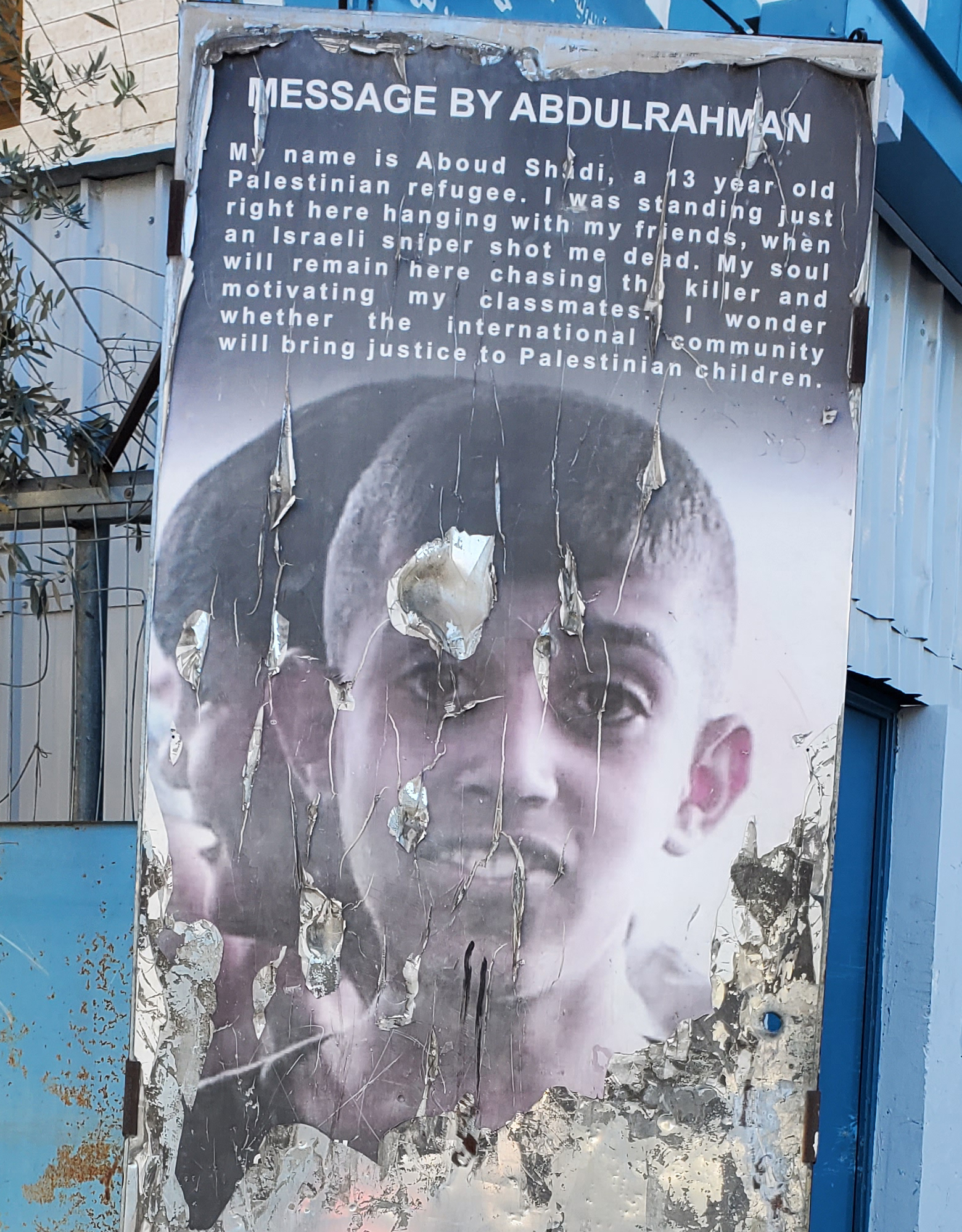
A few weeks earlier, 13 year-old, Abdel Rahman Abdullah, was shot and killed by the IDF while coming out of school. Ahmad’s son witnessed the shooting and now has nightmares and it was many months before he would go back to school.
I took some pictures including the poster of Abdel on the wall of the school. I regret not taking Ahmad.s contact info to get an update on his family and once again share a cup of tea. Once, when at the camp, a young girl took me by the hand and up to where she lived. Her mother insisted on giving me some food. There were holes in the glass where shots had been fired and a boy showed me where a bullet had grazed his head.
You wonder how this goes on and the world is silent and we watch this colonization going on in real time. And those of us with the good fortune of being with Palestinians know of their kindness and hospitality and weep at the way they are dehumanized as if their lives have no value.
I had been in the West Bank in November 2023. It was a very difficult time and the despair and hopelessness and the fear that the genocide would come to them was a real.. Abed asked me if Jesus was on the side of Israel as many churches support Israel. I told him that Jesus would never be on the side of the oppressor but stands with the oppressed and weeps with them. He expressed hope that at least one of his children will survive the genocide. Then there were barriers everywhere and it was hard to get to Yatta. And schools were closed and all the villages were sealed off so and travel greatly restricted. Abed’s mother wept every evening as she watched the news.
This time I saw that people did not remain in that hopeless state and despite the challanges including massive unemployment, they got on with their lives. Perhaps it is a form of resistance. To stay and not become like their tormentors or allow their tormentors to rob them of their humanity and right to be in the land. And not be pushed into vengeance but continue peaceful resistance and “samud” – steadfastness. If you ask me, the Palestinians are an example for all of us.
Before leaving, I also visited Qalandia (or Kalandia) Refugee camp considered part of E. Jerusalem. To learn more about this RC, click on this link. It is very crowded and there are frequent incursions by the IDF. To get to the RC, you first have to cross at the Qalandia chreckpoint between E. Jerusalem and Ramallah.
I also took a taxi to visit Tent of Nations . However, I did not get there since we were detained by the IDF for an hour and a half and told we could not longer take that route and had to go a longer way. I felt bad for the driver as he was nervous when stopped.
How much more can Israel do to make life miserable? How many more lies can they tell and they are believed. When is truth going to be exposed and change come? Or will this go one until Palestinian history, culture, and the very name is erased.
P.S. Today as I finish writing this, the headline in Mondoweiss News is Jenin is ‘only the beginning’: Israel moves its war on Palestinians to the West Bank. The genocide that Abed feared may indeed come. How long O, Lord must this continue before justice prevails?
 In the West Bank